Moving a grand piano yourself is one of the riskiest jobs in any house move. The steps in this guide explain how it is done, but it also helps to understand why each stage matters, where things most often go wrong, and when to step back and call in trained help.
You have to take some necessary steps to move your upright pianos or baby grand or grand pianos to your new location safely. Your upright piano or baby grand or grand piano is most likely the biggest and most costly piece of furniture goods in your apartment. The littlest baby grand pianos weigh about 400 to 500 lbs. and largest grand pianos weigh up to 1500 lbs., so you will need necessary help taking apart and shifting your piano.
Remove the music holder; generally, this slips out in the direction of the front of the piano. Remove the music stay, your pedal procedure, and the soundboard lid and cover prop. The pedals are held with nails or keys etc. Shut the piano lid if probable, and place a combined furniture pad on top to keep it from moving or becoming scored.
Brand the little equipment items with protecting tape and marking. Protect the rest of the piano with furniture shields, using big rubberized rings or tape to keep them in place. Point the piano onto a dolly and hold it while wheeling it to its next place or to a truck with a liftgate. Use the piano panel as a skid and an additional backing strap if the piano must be moved up or down steps.
Place a piano board with its increased brace near the piano keypad and equivalent to the smooth side of the piano. Point the piano left corner first onto the piano board. Place the piano board on the floor by the front left area. Clear away the other two hip and legs, cover them separately in furniture pads and brand them. Safe the piano by attaching the piano panel shoulder straps jointly and then move it to your new apartment securely.
We are the Professional and reliable Piano Movers in Sydney.
On this page
Where Moving a Grand Piano Goes Wrong
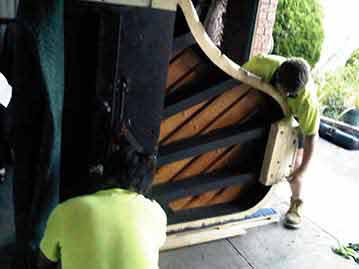
Most damage happens during the tip onto the piano board. While the body is tilted, the legs and lyre carry heavy loads at odd angles, and a snapped leg or a lyre caught underneath can mean an expensive repair. The body must be fully supported before any leg comes off.
The next risk is the route. A piano on its side is long, heavy and hard to see past, so doorframes, banisters and walls take knocks if the path is not planned and padded. Stairs multiply the danger, because the board has to be controlled from above and below at once.
Loading is the final hurdle when moving a grand piano. A vehicle with a ramp or liftgate and solid tie-down points is essential, and the piano should stay strapped to its board so it cannot slide on corners or under braking. Never transport it standing on its legs, even for a short trip.
Reassembly needs just as much care. Legs must be refitted while the body is still supported, and the piano lowered onto them slowly and evenly. Rushing this last step, when everyone is tired, is when many accidents happen. Once it stands, check every leg is seated firmly before anyone lets go.
Signs You Should Not Do It Yourself
- There are stairs, steps or a steep path at either end of the move
- You have fewer than four strong, careful helpers who can stay for the whole job
- The piano is larger than a baby grand piano
- You have no piano board, straps or suitable dolly, and no way to hire them
- The instrument is valuable, a family heirloom or simply irreplaceable to you
If moving a grand piano sounds like more than you want to take on, our page on moving grand pianos explains how Piano Removalists Sydney does it with trained piano removalists and the right equipment. Whichever way you go, book a tuner once the piano has settled.
Moving a Grand Piano Between Floors
Moving a grand piano up or down stairs needs a piano board, a stair-rated strap system and at least three experienced people. Before moving a grand piano, we measure every turn, protect the walls and plan where the body will be turned on its side.
If the stairs are too narrow, moving a grand piano through a balcony or with a crane may be the safer option, and we will tell you that before the day. Moving a grand piano this way costs more, but it protects the instrument and your home.

